
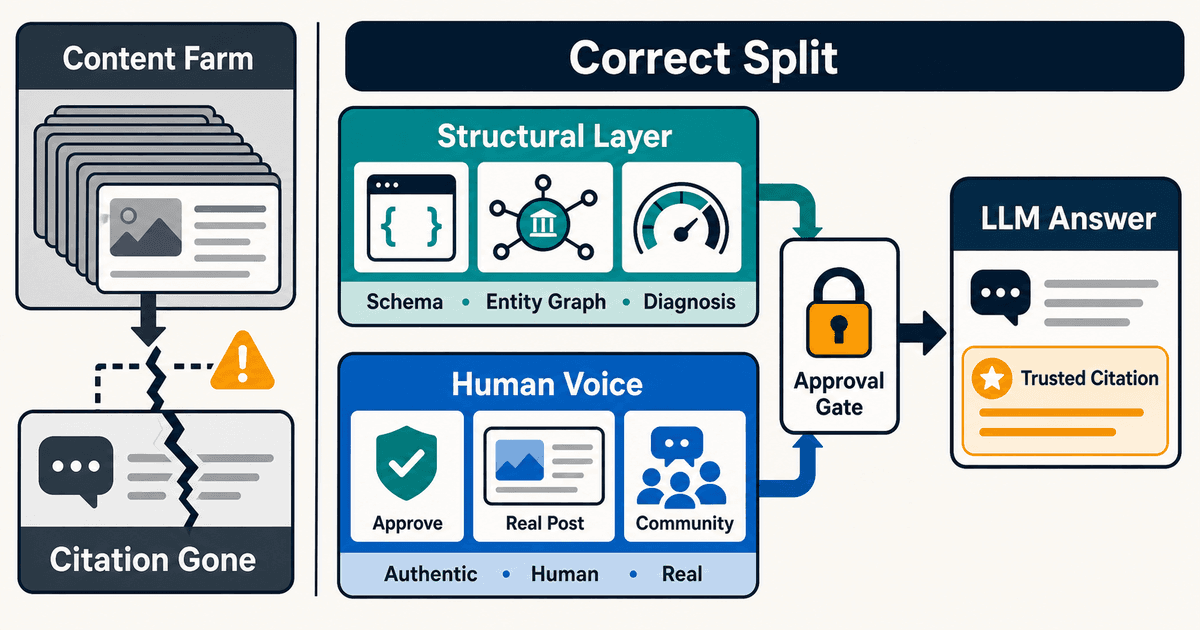
In March 2026, China's CCTV 315 consumer rights programme broadcast a segment on what it called "AI poisoning" — operators mass-generating low-quality articles to make brands appear in AI-generated answers. One case profiled a smartwatch brand whose operator had seeded thousands of articles across platforms. For a brief window, the brand started showing up in Doubao and ERNIE answers.
Two weeks after the broadcast, every citation was gone.
This isn't a China-specific pattern. The mechanics of how AI citation works — and why volume-seeding fails — are universal. Understanding why the 315 case collapsed so fast is the clearest way to explain what ethical AI visibility actually is.
Why farmed citations collapse
AI models don't cite sources the way a human fact-checker would. They maintain an internal model of which entities are verifiable and trustworthy, updated through training and, for real-time retrieval models, through live crawl signals.
When a brand appears only in a mass of structurally similar, low-quality articles — with no canonical on-site entity to resolve citations back to — several things happen simultaneously:
Entity resolution fails. Perplexity, ChatGPT, and Kimi all attempt to verify a cited brand against its official site. If the site is missing, uncrawlable, or structurally empty, the citation can't be resolved. It doesn't compound; it dissolves.
Platform anti-spam fires. Zhihu, Toutiao, and Bilibili have trained detection against coordinated volume injection. When the 315 broadcast drew attention, human moderation followed automated detection. The content network collapsed within days, taking the citation signal with it.
Retraining corrects for the anomaly. Models retrain every 3–6 months. An anomalous brand that appeared briefly in citations — without the corroborating signals (Wikipedia entry, Baidu Baike, industry press, organic forum discussion) that models use to verify entity authority — doesn't survive the correction cycle.
The 315 smartwatch brand was invisible after two weeks not because the platform made a policy decision. It was invisible because AI systems had no durable entity to cite.
What the farms were selling
The pitch was simple: "We post on your behalf. Your brand appears in AI answers. You pay monthly."
This is the same pitch as traditional PR distribution — ghostwrite content, flood channels, measure impressions. The farm operators applied that model to AI visibility without understanding that AI visibility doesn't work on impressions.
AI citation measures entity trust, not volume. A brand that appears in 10,000 AI-generated articles with no canonical on-site entity is not more trusted than a brand with zero articles and a clean, machine-readable site. It may actually be less trusted — volume without corroboration is a spam signal.
Ongoing posting at scale requires either fake accounts or paying for real ones. Both options degrade over time. Platforms detect and filter coordinated posting. Real human accounts posting brand content without genuine expertise read as inauthentic and get lower engagement signals.
The operator owns the distribution channel, not the brand. If you outsource posting to a farm, you own none of the relationships, accounts, or community standing that authentic distribution builds. When the farm stops posting — or gets banned — your visibility disappears overnight.
The division that makes it durable
The 315 exposé didn't prove that AI visibility is impossible to build legitimately. It proved that outsourcing the human work to automation is the wrong model.
Here's what "dividing the work correctly" means in practice:
We own the structural foundation. Schema, llms.txt, entity graph, passages — these are engineered artifacts that sit on your site, persist across model retraining cycles, and give AI systems a canonical, verifiable entity to cite. This layer scales without per-unit cost once it's built. We build it; we update it monthly.
We own the diagnosis. Monthly monitoring across ChatGPT, Perplexity, Gemini, Doubao, ERNIE, and Qwen tells us where visibility is leaking, what competitors have done, and which scenarios your brand now owns or still needs to close. We turn that into a concrete playbook. This is intelligence work — it's what we're structured to do at scale.
We write the content. Insight articles for your site, distribution scripts for Reddit, Zhihu, industry forums, podcast pitches. We write the framework; we don't own the voice.
Your team owns the distribution. A post from your actual team member — real account, real expertise, real relationship with the community — carries a fundamentally different trust signal than a batch-posted article from an anonymous farm. AI systems that incorporate social corroboration signals (Zhihu upvotes, Reddit engagement, podcast listener counts) weight authentic engagement differently from synthetic volume.
Nothing is published in your name without your approval. This is the structural guarantee that separates ethical AI visibility from content farming. We are not in the business of posting for you.
What this means for ongoing visibility
The model that collapses under 315-style scrutiny is the one that promises to handle everything. You pay; we post; you appear. That promise requires faking your voice, faking your relationships, or buying them at unsustainable cost.
The model that doesn't collapse is the one that divides the job honestly. The foundation and diagnosis scale with AI capability growth. The distribution stays authentic because it stays in the hands of the humans who actually know the business.
One year from now, AI systems will be better at distinguishing authentic corroboration from synthetic volume than they are today. The brands that invested in the structural layer and built genuine distribution habits will be further ahead — not behind — because of that improvement.
The ones that bought farmed citations will have nothing left to show for it.
Related: Why the 2026 CCTV 315 fake-GEO case collapsed in two weeks — and what real GEO looks like (ZH)
DeepIntelli is an AI visibility research and advisory firm. Team backgrounds: SFU, NUS, INSEAD.