
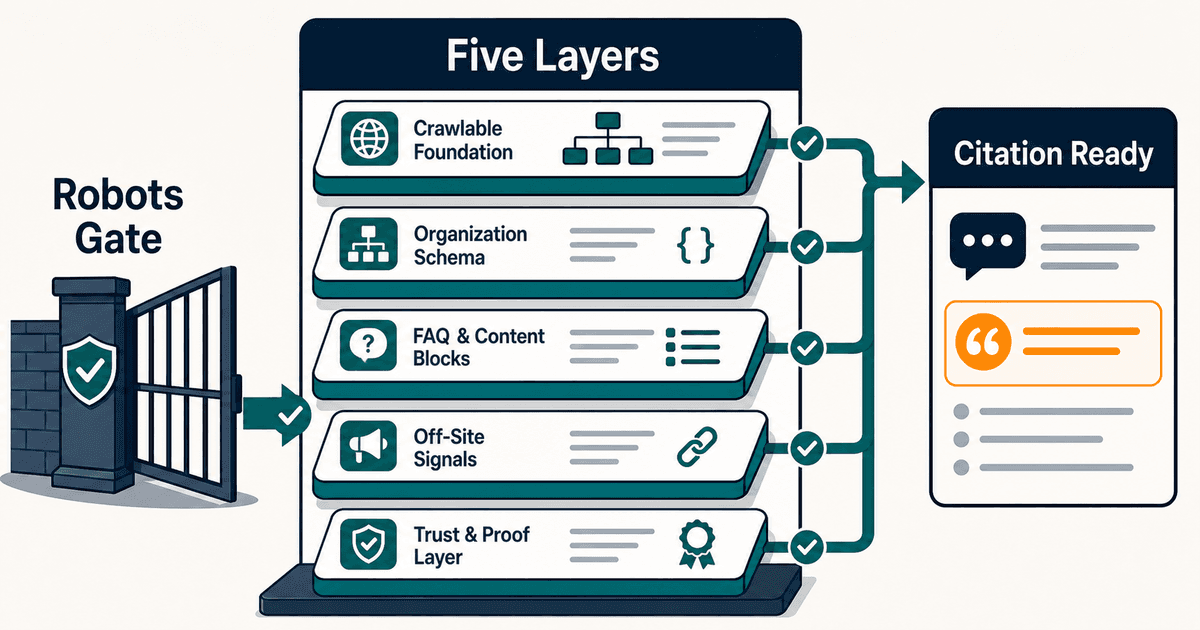
When we audited our own website for AI search visibility last month, we scored 61 out of 100. For a company that helps clients get cited in AI answers, that was a humbling number.
By making five specific structural changes, we reached 78/100 within four weeks — and started appearing in ChatGPT and Perplexity answers for queries we'd never appeared in before.
Here's exactly what we changed, and why each change matters.
1. We Fixed Bot Access (Score Impact: +8 points)
Our robots.txt was blocking Bytespider — ByteDance's crawler, which powers Doubao (one of China's largest AI assistants with 300M+ users). We'd never intentionally blocked it. It happened because we copy-pasted a robots.txt template from an older SEO guide that predated these crawlers' existence.
Check your robots.txt today. The crawlers to explicitly allow:
GPTBot(OpenAI/ChatGPT)Google-Extended(Gemini)PerplexityBot(Perplexity)Bytespider(Doubao/ByteDance)anthropic-ai(Claude)cohere-ai(Cohere)meta-externalagent(Meta AI)
If you're using a CDN or WAF (Cloudflare, etc.), check that it's not rate-limiting or blocking these user agents at the infrastructure level.
2. We Added Organization Schema with sameAs Links (Score Impact: +12 points)
This was the single highest-impact change.
AI systems like ChatGPT use sameAs in your website's JSON-LD schema to verify brand identity. When the schema says "this company also exists at linkedin.com/company/X and reddit.com/user/Y," the AI can cross-reference those signals and confirm the brand is real before citing it.
Before: our Organization schema had our name, URL, and description. No sameAs.
After: we added links to our LinkedIn company page, Crunchbase, and GitHub profile.
The template looks like this:
{
  "@type": "Organization",
  "name": "DeepIntelli",
  "url": "https://www.dpintelli.com",
  "sameAs": [
    "https://www.linkedin.com/company/deep-intelli-geo",
    "https://www.reddit.com/user/DeepIntelliGEO"
  ]
}
Every time you create a new off-site profile, add it here. It compounds.
3. We Restructured Content as Q&A (Score Impact: +6 points)
Large language models are trained on a massive corpus of Q&A data. The instruction-tuning process specifically teaches them to extract question-answer pairs from text. Pages structured as explicit questions and answers are cited at significantly higher rates than equivalent content in paragraph form.
We added an FAQ section to our homepage and created a dedicated /faq page. Each FAQ item uses FAQPage JSON-LD schema in addition to the visible HTML structure.
Two things we got right:
- Questions match real phrases people type into AI assistants ("What is GEO?", "How is GEO different from SEO?")
- Answers are self-contained — AI can quote a single answer without needing surrounding context
4. We Added BreadcrumbList Schema to Every Page (Score Impact: +4 points)
Breadcrumb schema helps AI understand the structure of your site and how pages relate to each other. More practically, it gives AI assistants the context to accurately describe where on your site a piece of information lives.
Before: only the homepage had any schema.
After: every page has both Organization schema (entity identity) and BreadcrumbList schema (content navigation).
5. We Built Off-Site Brand Signals (Ongoing — Score Impact: +5 points so far)
This is the part that takes the most time but matters most. Our Brand Mentions score started at 2/100 — essentially zero off-site presence.
The research is clear: AI systems weight off-site mentions heavily in brand authority. According to an Ahrefs analysis of 75,000+ brands (December 2025), Reddit and YouTube mentions correlate 3x more strongly with AI citation than traditional backlinks.
What we've done so far:
- Created this LinkedIn company page
- Started participating in relevant Reddit communities (r/SEO, r/entrepreneur)
- Drafted our Baidu Baike entry for Chinese AI search engines
What we're working on:
- YouTube explainer series
- Zhihu presence for Chinese market
- Wikipedia notability (requires significant external coverage first)
The Compound Effect
The reason these changes work together is that AI citation is fundamentally a trust problem. An AI model needs enough confidence that your brand is legitimate and authoritative before it will stake its credibility on recommending you.
On-site signals (schema, bot access, Q&A content) say "I'm here and I'm real."
Off-site signals (Reddit, LinkedIn, Baike) say "other people know I'm real."
The combination is what moves the needle from "not appearing in AI answers" to "regularly cited."
Our score went from 61/100 to 78/100 with these changes. Getting above 80 requires the off-site signals to compound over the next few months.
If you want to see where your site stands, we run AI visibility audits at www.dpintelli.com.
DeepIntelli is a GEO (Generative Engine Optimization) agency helping brands become the answer in AI-powered search. PhD team from SFU, NUS, INSEAD.