
The search landscape changed faster than most marketing teams noticed
In early 2023, a typical buyer researching a B2B software category would type a query into Google, scan ten blue links, and click through to compare vendors. By 2025, a growing share of that same buyer asks ChatGPT, Perplexity, or Gemini: "What's the best tool for [problem]?" — and reads a synthesized answer that cites two or three sources directly.
That shift is not a trend. It's a structural change in how information is consumed and how purchasing decisions begin. And the optimization discipline required to appear in those AI-generated answers is fundamentally different from SEO.
What changed: how AI models serve information
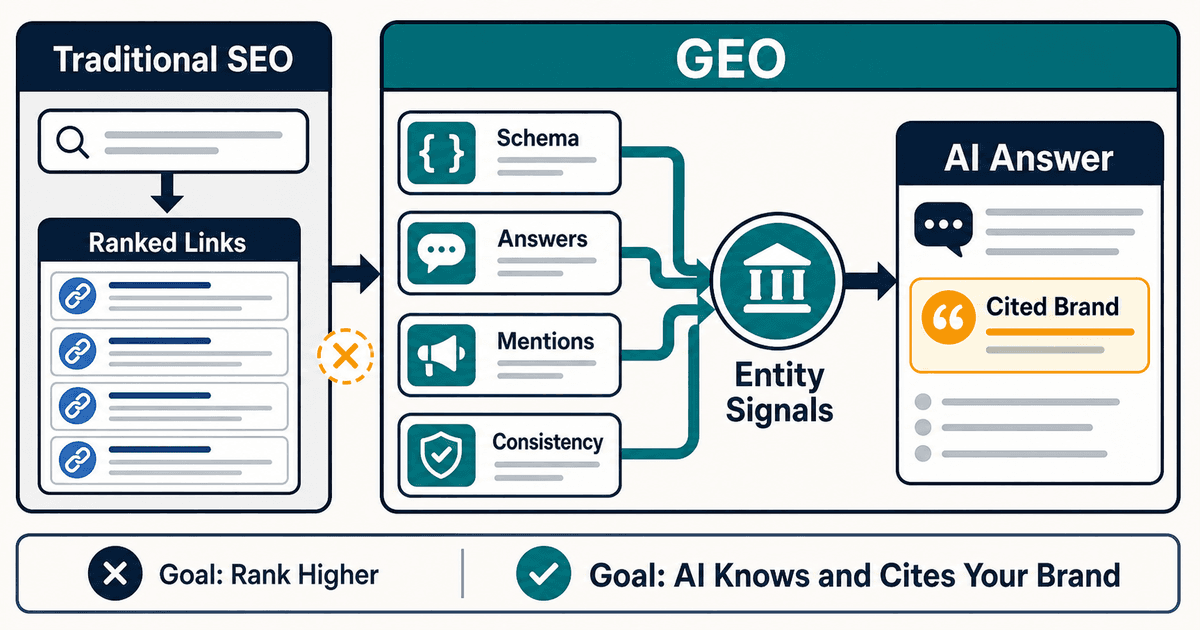
Traditional search engines operate on a retrieval-and-ranking model: crawl pages, index them, rank them by authority and relevance signals, return a list.
AI answer engines operate on a synthesis model: retrieve relevant content from a knowledge base (either static training data or live retrieval), identify the most credible and coherent sources, and generate a new answer that cites those sources.
The ranking signal shifts from link authority (who links to you, PageRank-derived) to entity authority (is your brand a well-defined, cross-referenced, consistently described entity across the web?).
This distinction matters practically. A website with strong backlinks but weak structured data and thin explanatory content may rank #1 on Google and appear nowhere in a ChatGPT answer about the same topic.
How AI systems decide what to cite
Research from Princeton University (Aggarwal et al., 2023 — arxiv.org/abs/2311.09735) introduced the term Generative Engine Optimization and identified key content signals that increase citation probability in AI-generated answers:
- Authoritative language and direct statements — content that states facts cleanly, not hedged marketing copy
- Question-answer structure — FAQ-style or explainer content maps directly to the query patterns AI assistants receive
- Quotable statistics and data points — AI models prefer citable specifics over vague claims
- Entity consistency — the same brand name, description, and identifiers appearing coherently across multiple sources
Beyond content signals, AI models that do live retrieval (Perplexity, Bing Copilot, ChatGPT Browse) also weight recency and off-site mention density — how frequently a brand is mentioned in forums, directories, blogs, and social platforms.
What GEO actually does
Generative Engine Optimization is the practice of structuring a brand's web presence to maximize citation probability in AI-generated answers. It operates across four layers:
1. Technical entity signals
This includes structured data (Organization schema with a fully populated sameAs array pointing to LinkedIn, Crunchbase, Wikipedia, Wikidata, and other authority sources), FAQPage markup for speakability, and breadcrumb/navigation schema for content hierarchy.
2. Content architecture Rewriting key pages to lead with direct answers rather than marketing pitches. A "What is [service]?" page that explains the methodology clearly will outperform a features page in AI retrieval almost every time.
3. Off-site citation building Creating or earning mentions in the platforms AI models source from: industry publications, forum threads (Reddit, Quora, Stack Overflow), directories, partner pages. This is the slowest signal to build and the one most brands have at zero.
4. Cross-platform consistency Ensuring the brand name, description, and category appear identically across all indexed surfaces, so AI models can confidently attribute citations to a single entity rather than flagging ambiguity.
Three practical steps to start
Step 1: Run a schema audit.
Check whether your Organization markup includes sameAs identifiers. Most sites don't have this field populated at all. Add links to your LinkedIn company page, Crunchbase profile, and any Wikipedia or Wikidata entries that exist for your organization. This is a one-hour fix with measurable impact.
Step 2: Audit your content for question-answer density. Take your 10 most important landing pages. For each one, ask: "Does this page directly answer a question a buyer would ask an AI assistant?" If the answer is no, add a structured FAQ section or rewrite the intro to lead with the answer.
Step 3: Establish a baseline citation score. Manually query ChatGPT, Perplexity, and (if relevant) Doubao or ERNIE Bot with 5-10 queries relevant to your service category. Record whether your brand appears. Do this monthly. You cannot improve what you don't measure.
A real case: auditing our own site
Before recommending GEO audits to clients, we ran one on ourselves at www.dpintelli.com.
The result: 61/100.
Key gaps: no sameAs identifiers in Organization schema, no FAQPage markup, homepage content structured for conversion rather than explanation, and zero off-site brand mentions.
After fixing the schema and rewriting two key content sections to be explanation-first, we moved to 78/100. The remaining distance to 90+ is almost entirely the off-site citation density problem — which is real work, not a technical fix.
The honest lesson: GEO is not a one-time audit. It's an ongoing investment in being a known entity across the platforms where AI systems are trained and where they retrieve.
Conclusion
SEO optimized for the assumption that buyers would scan links. GEO optimizes for the assumption that buyers will read AI-synthesized summaries.
Both are true simultaneously right now. But the share of journeys that start with an AI query is growing every month. Brands that start building entity authority today are building a compounding advantage — because citation patterns in AI training data tend to reinforce themselves over time.
The first question isn't "how do I rank?" — it's "does AI even know I exist?"
DeepIntelli helps brands build measurable presence in AI-generated answers across ChatGPT, Perplexity, Gemini, and Chinese AI platforms. Contact: contact@dpintelli.com | www.dpintelli.com/en