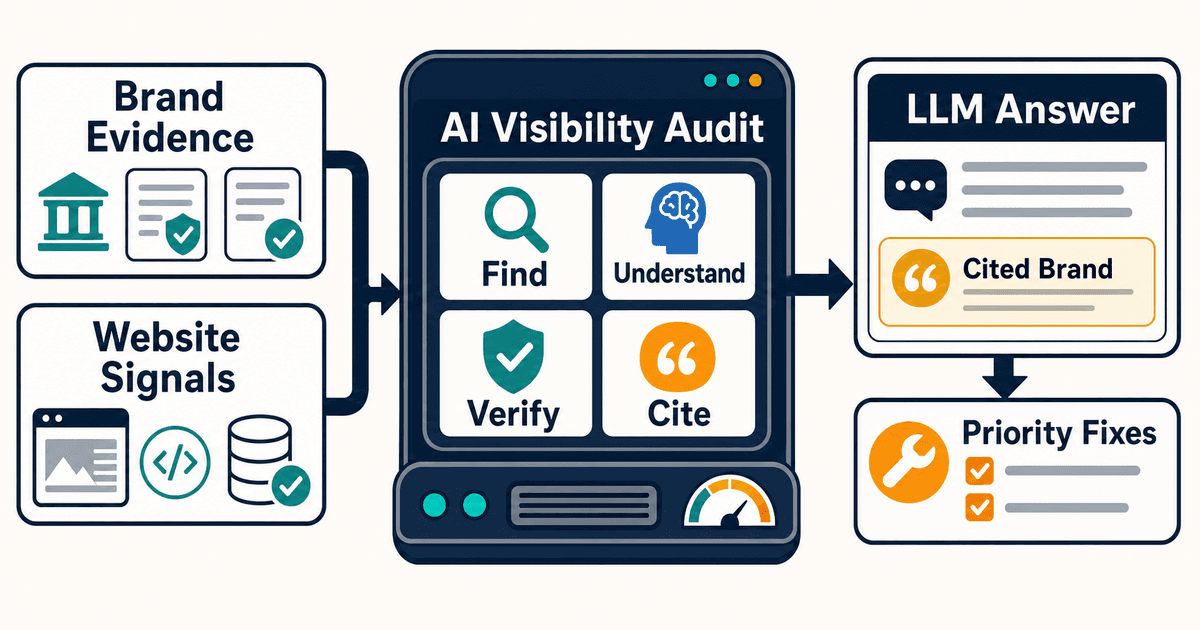
An AI Visibility audit is not a vibe check or a single vanity score. It measures six concrete things, each weighted in our scoring model by how much it moves whether AI engines cite you — with AI Visibility itself carrying the most weight. Some of those things will surprise you — they have nothing to do with how polished your website looks.
This piece walks through each of the six dimensions, what it means for your brand in plain terms, and what you will see in your report. If you are new to why AI answers changed the game, start with what GEO is and why SEO is no longer enough.
1. Are you showing up in AI answers? (AI Visibility — the biggest factor)
This is the heaviest-weighted dimension in the audit — the single biggest factor in whether AI cites you. Everything else in the six areas is either a prerequisite for it or a lever that moves it. The question is direct: right now, today, if a buyer asks ChatGPT, Perplexity, or Gemini about your service category, does your brand appear in the answer?
Most brands have never checked this systematically. They assume they would know if AI was ignoring them. They would not. In the audits we run, organic search rankings and AI citation rates line up far less often than teams expect — a site that ranks on the first page of Google for its core terms can score very low on live AI probes for the same queries.
Beyond whether you appear, there is a second layer: can AI crawlers even reach your pages? A site that blocks the wrong user agents renders all other work irrelevant. The audit checks both the outcome (are you cited?) and the prerequisite (can you even be reached?).
In your report, you'll see: per-platform live probe results across the AI engines your buyers use, with citation rates broken down by query type.
2. Does the web describe your brand consistently? (Brand Authority)
Brand Authority is another heavily weighted dimension, and captures something SEO never had to care about: whether AI can confidently attribute a citation to your specific organization rather than getting confused or abstaining.
AI engines work differently from a search algorithm. Before citing a brand, a model needs enough cross-referenced, consistent signals to be confident the brand is a real, well-defined entity. If your LinkedIn says you are a "content marketing agency," your Crunchbase says "AI marketing platform," and your website says "growth consultancy," the model sees ambiguity. When it is uncertain, it cites someone else who is clearer.
Brand Authority is built across the sources AI models cross-reference — LinkedIn, Crunchbase, G2, Wikipedia, industry directories, and third-party coverage — not just your own site. A brand with a handful of well-maintained, mutually consistent off-site profiles will score higher than a brand with a polished website and no off-site presence at all.
In your report, you'll see: a brand-presence map showing where you exist, where you are missing, and where your descriptions conflict across the platforms AI models source from.
3. Is your content credible enough to quote? (Content & E-E-A-T)
This dimension also weighs heavily: it measures whether your content reads like something worth citing — or like marketing copy an AI will politely skip past.
"E-E-A-T" stands for Experience, Expertise, Authoritativeness, and Trustworthiness, a framework Google formalized that captures the same credibility signals AI models use when selecting sources. A model generating an answer about a business problem is not looking for the most confident-sounding paragraph on the topic. It is looking for the paragraph that makes a direct, verifiable claim it can repeat without hallucinating.
Content that leads with direct answers, names specific methodologies, and attributes claims to evidence earns citations. Content that leads with "we are passionate about helping businesses grow" does not.
This section of the audit also looks at whether your site has explanatory content — articles, FAQs, and methodology pages that answer the questions your buyers are already asking AI assistants.
In your report, you'll see: content credibility findings, including specific pages where the framing works against citation and what to change.
4. Can AI crawlers actually read your site? (Technical foundation)
The technical foundation dimension — important, though lighter-weighted — is the one that feels least glamorous and causes the most silent damage. The issue is rendering: many modern websites are JavaScript-heavy, meaning the actual content only appears after client-side code runs in a browser. Most AI crawlers do not run JavaScript. They fetch a URL, get back an empty shell, and move on.
A site that renders beautifully in Chrome and returns nothing useful to a crawler is effectively invisible to the AI engines that power it. The content might as well not exist.
The audit checks whether your key pages deliver readable, indexable content to the crawlers that matter — not just whether they load in a browser. It also checks for robots.txt directives that may be inadvertently blocking crawlers you want to allow.
In your report, you'll see: crawlability and render findings per page, flagging any pages that return thin or empty content to AI crawlers.
5. Do your pages tell machines what they are? (Structured data)
Structured data — one of the lighter-weighted dimensions, but a decisive one — is the difference between a page that describes what it is and a page that makes AI guess from the prose.
In plain terms: structured data is a small block of machine-readable code on your page that says "this is a product," "this is a company," "this is a person," "this is an FAQ" — rather than leaving the AI to infer that from the surrounding text. When the inference is wrong or uncertain, the page does not get cited.
The most important structured data for AI visibility is Organization schema (your entity identity) with sameAs links pointing to your LinkedIn, Crunchbase, and other verified profiles. After that: FAQPage markup on any Q&A content, and Product or Service schema on pages where you describe your offer. Many sites have Organization schema but have left the sameAs array empty — which is the single field that does the most to confirm you are a real, cross-referenced entity.
In your report, you'll see: a structured data gap analysis covering which schema types are present, which are missing, and which are present but incomplete in ways that suppress citation.
6. Are you ready for the engines your buyers use? (Platform readiness)
The final dimension addresses a question that most audits ignore entirely: AI is not one engine. ChatGPT, Perplexity, Gemini, and the major Chinese AI platforms (Doubao, Baidu ERNIE, Kimi) have different retrieval architectures, different crawler policies, and in some cases entirely different citation patterns. What works for Perplexity does not automatically work for Doubao.
Platform readiness checks whether you are set up for the specific engines your buyers use — not a generic average. For a brand selling into the Chinese market, Doubao readiness may matter more than Perplexity readiness. For an international B2B brand, the weighting shifts in the opposite direction. The audit is calibrated to your audience.
In your report, you'll see: per-platform readiness ratings, with specific gaps called out for each engine relevant to your target market.
What the report delivers
An AI Visibility audit produces a scored breakdown across all six dimensions above — so you know not just your headline score, but exactly which area is holding you back most and by how much. Alongside the scores, the report includes per-platform live probes (what AI actually says about you, recorded at audit time), competitor benchmarking where the probe data supports it, and a prioritized action plan rated by effort and impact. The most common finding: two or three concentrated fixes that would move the score meaningfully, rather than a sprawling to-do list.
This is not SEO with a new label — the signals AI engines weigh barely overlap with the ones that move Google rankings, and the value is in measuring all six against live AI answers at once, the way buyers actually encounter you. You can't fix what you can't see: the AI Visibility Check shows you exactly where you stand across all six dimensions — and where to start.
DeepIntelli helps brands build measurable presence in AI-generated answers across ChatGPT, Perplexity, Gemini, and Chinese AI platforms. Contact: contact@dpintelli.com | visibility.dpintelli.com/en

